
Every year, in late August, companies start thinking about how to close out the year with their team. The default option is still the same: book a restaurant, seat the workforce, raise a toast. More and more companies are realising that formula, repeated year after year, has stopped producing the effect they're after.
The problem isn't the dinner, it's the repetition
A well-organised Christmas dinner — good food, a good venue, enough time for conversation afterwards — is still a solid foundation, and for many companies it's exactly what they need. The problem shows up when that format repeats year after year with no new element, and the team starts anticipating the event as another social formality rather than something they look forward to. The fatigue doesn't come from the format itself — it comes from the lack of variation.
From decoration to concept: what's changed
For years, "differentiating" the Christmas dinner meant adding themed decoration on top of the same format as always. What companies that get their team talking about the event weeks later are doing is different: they build the year-end close-out around their own narrative concept, with a recognisable reason behind it — not decoration layered on a standard dinner, but an event designed from scratch around an idea.
Storytelling as structure, not decoration
A well-resolved narrative concept isn't a visual theme — it's a structure that organises every other decision in the event: the music, how people move through the space, when each moment happens. A year-end close-out with its own narrative thread has a recognisable beginning, high point and ending, the same way any well-told story does. Without that structure, the theme stays at the level of balloons and tablecloths in the right colour.
Case study
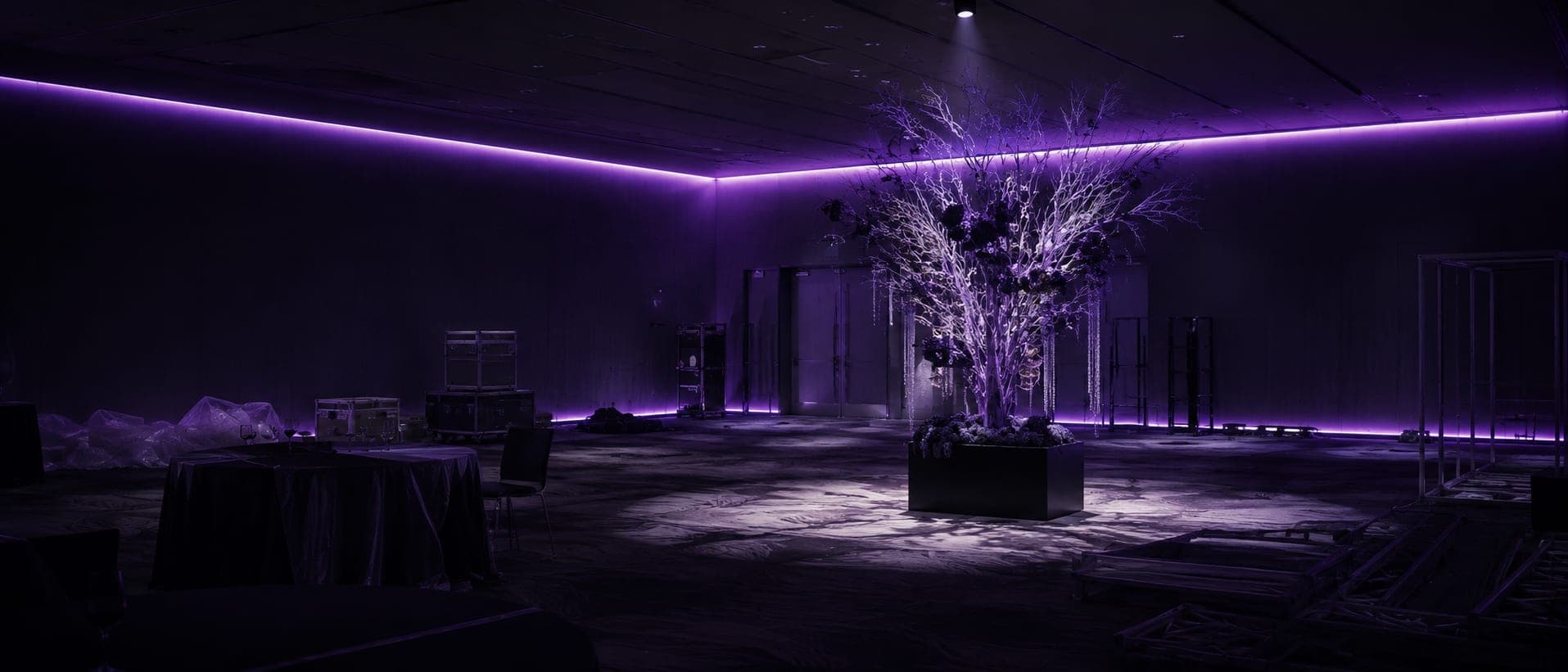
Novarama Pesadilla antes de NavidadYear-end party for Novarama built around a "Nightmare Before Christmas" narrative concept — a close-out that replaces the standard dinner with a complete themed world, with a narrative thread from start to finish.
The surprise element, used sparingly
Surprise works when it's saved for one or two specific moments in the night, not when it's stretched across the whole event — that exhausts attendees instead of building anticipation. An unexpected turn midway through dinner, a well-produced reveal moment, or a closing nobody sees coming generates more conversation afterwards than an entire night of constant surprises the team stops processing after the first half hour.
Why this matters beyond the party itself
A well-designed year-end event isn't just a one-off reward — it's one of the few occasions in the year when the whole workforce shares a common experience, something that later becomes a shared reference point within the company's culture. That effect is almost entirely lost when the event is indistinguishable from the year before, no matter how good the food or the venue were.
Involving the team in the concept, not just attendance
Asking the team for input on what kind of year-end close-out would interest them — even informally, through a short survey — changes how the event is perceived before it even happens. A close-out that feels designed with the team in mind, rather than simply imposed from management, generates more anticipation beforehand than any decoration, however striking.
Budget doesn't have to spike to innovate
Changing format doesn't necessarily mean spending more. A well-resolved narrative concept built around two or three elements with real impact — lighting, a reveal moment, music consistent with the theme — creates more lasting memory than a larger budget spread across many minor details with no thread connecting them. The innovation is in the design, not necessarily in the final number on the invoice.
When to start planning it
December concentrates the highest demand for venues and suppliers of the year — anyone who starts designing the concept in October is already late for the best options. Booking the venue two to three months ahead, and using September to define the narrative concept before browsing decoration catalogues, is what separates a well-resolved year-end close-out from one improvised in the final weeks of November.
The question that actually makes the difference isn't "what decoration are we using this year" but "what will the team talk about the following Monday". If the answer is just "it was nice", the event hasn't done its job.