
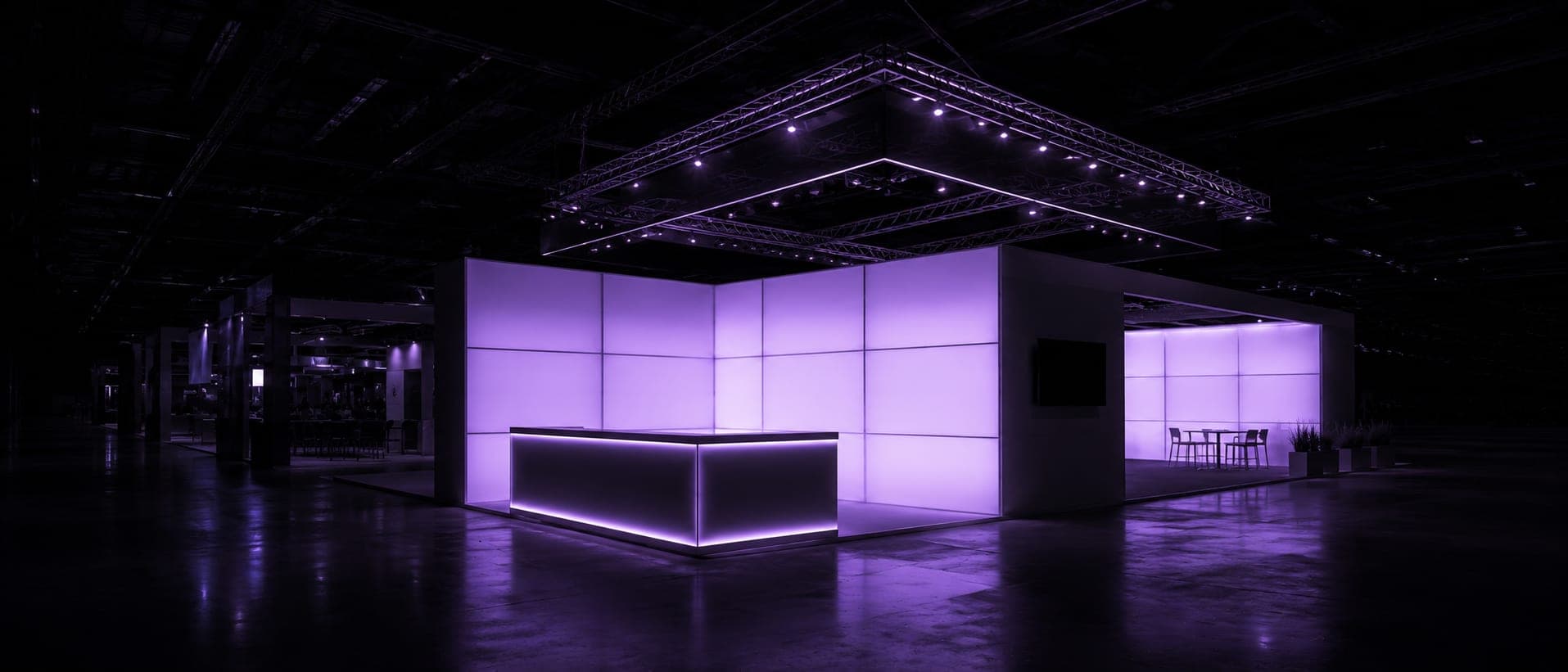
A trade fair stand has a problem no closed-door event shares: the visitor hasn't decided to attend, they decide every second whether to approach or keep walking. The entire stand design has to resolve that decision before the person finishes walking past.
Visibility from the aisle
What's visible from ten metres away matters more than what's visible up close. A stand with a message legible at a distance, enough height to stand out from the rest, and a visual element recognisable from several angles catches people who haven't yet decided to stop. Detailed content — spec sheets, demos, conversation — is for those who have already approached, not for capturing initial attention.
Elements that generate traffic
A stand attracts more visits when it offers something to do, not just something to look at. A live product demo, a screen running looped content visible from the aisle, a quick-entry giveaway or an interactive activation keep people around longer than a standard sales conversation would. That extra dwell time is, by itself, added visibility: a stand with people around it attracts more people than an empty one, even if the product is identical.
The sales team is part of the design
A well-designed, badly staffed stand doesn't convert. Stand staff need specific training: how to approach without intruding, how to qualify within the first thirty seconds whether a longer conversation is worthwhile, and a clear system for logging contacts that doesn't rely on paper business cards that get lost.
What to ask before designing
- What's the exact allocated floor space and the fair's technical restrictions (height, power supply, fixings)?
- Is a private meeting area needed, or does all contact happen in the open aisle?
- Is the goal to generate leads, close meetings already booked, or build sector brand visibility?
- Which direct competitors' stands will be nearby, and is it worth differentiating visually from them?
Modular stand or custom-built stand
A modular stand is built from reusable systems — aluminium structures, reconfigurable panels — that can be dismantled, stored and reassembled at another fair with variations in floor space. It lowers the per-edition cost when the company attends several fairs a year, though it limits customisation. A custom-built stand is designed and built from scratch for a specific floor space and message, with more formal freedom but no direct reuse afterwards. The choice depends on how many fairs the company attends per year and on whether the message changes from one edition to the next.
Storage and material logistics
Storage between fairs is a cost that's easy to forget when budgeting. A modular stand reused across several editions needs controlled warehouse space — humidity, temperature — between events, and that recurring cost has to be added to the savings from not rebuilding the stand every time. Sometimes a simpler, lower-cost stand that can be built and struck quickly works out better than a more elaborate one that requires a heavy-tonnage truck and dedicated storage for the months it isn't in use.
A stand's budget isn't just the design
On top of design and build costs, add the fair's floor space rental (usually set by the organiser, non-negotiable), transport of materials, build-up and tear-down, and stand staff for every day of the fair. A budget that only covers stand construction and forgets these items usually overruns during production.
Case study
BAYWA Stand GeneraCorporate stand for BayWa r.e. at the Genera fair in Madrid, designed and produced end-to-end for a leading renewable energy brand.
How much lead time production needs
The timeline depends on size and on whether the stand is modular or custom-built, but as a reference: a medium-size custom stand needs six to eight weeks from brief to build-up, including design, sign-off with the fair organiser (who usually reviews safety and access plans) and production. Leaving less margin forces cuts to review stages or rush-production surcharges, and both show in the final result.
Case study
Wallbox Stand Automobile BarcelonaStand for Wallbox at Automobile Barcelona, in Fira Gran Via, designed for an electric charger manufacturer in a high-visitor-volume fair environment.
Post-fair follow-up of the contacts generated decides whether the stand was a profitable investment or just presence. Without a clear process for what happens to each contact in the following 48 hours, much of the stand's work is wasted.